
doi: https://aacrjournals.org/cancerres/article/86/7_Supplement/1211/776992
Poster
Abstract
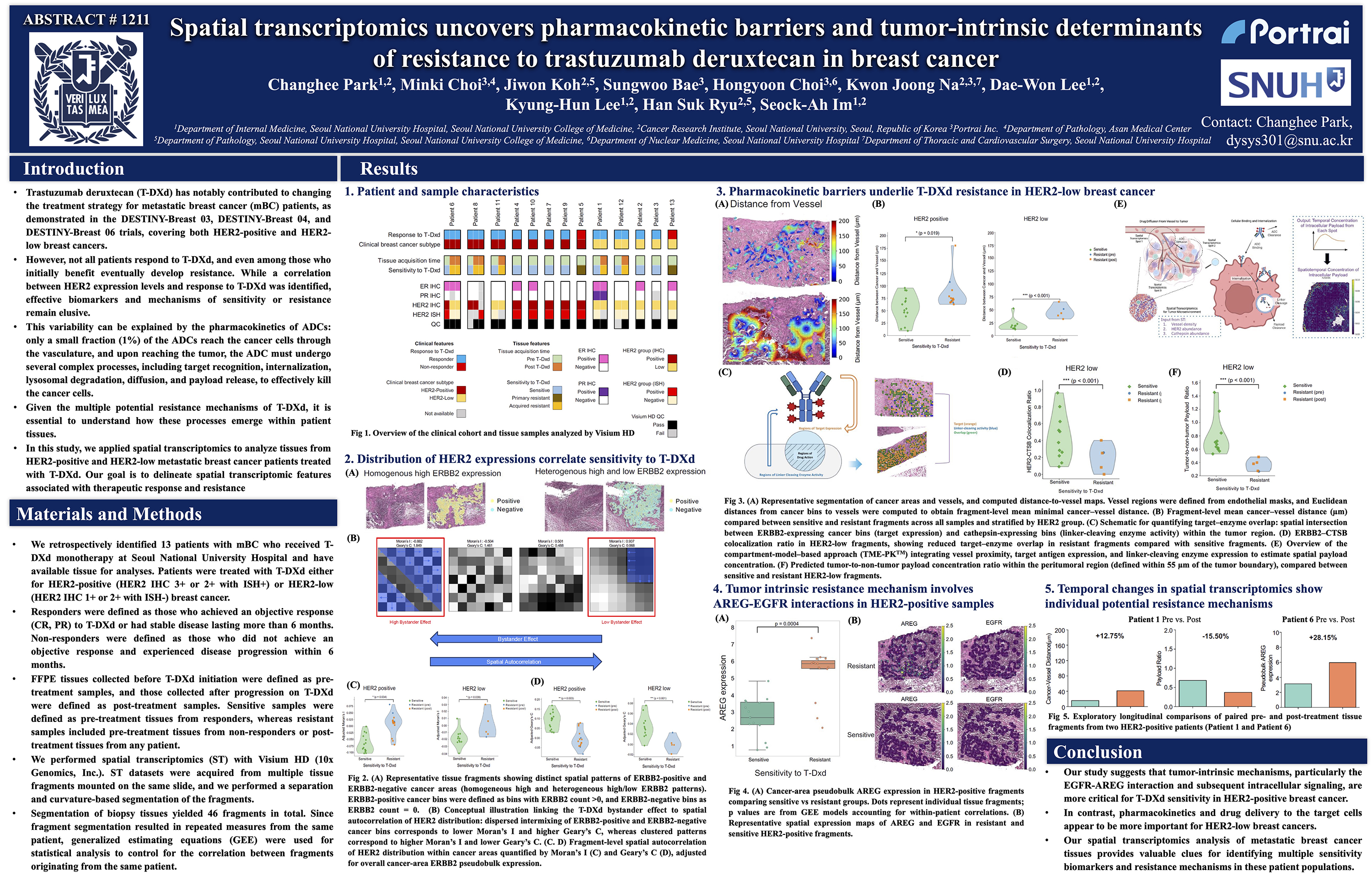
Introduction: Trastuzumab deruxtecan (T-DXd) is an antibody-drug conjugate (ADC) that is effective for both HER2-positive and HER2-low metastatic breast cancers (MBC). While correlation between HER2 expression levels and response to T-DXd was identified, effective biomarkers and mechanisms of sensitivity or resistance remain elusive, partly due to complex pharmacokinetics of T-DXd. Our goal is to delineate spatial transcriptomic (ST) features which is associated with therapeutic response and resistance to T-DXd.
Methods: We performed ST with the 10x Genomics Visium HD on formalin-fixed paraffin-embedded tumor tissues from patients with MBC treated with T-DXd. Responders to T-DXd were defined as patients who experienced objective response or stable disease for more than 6 months, and non-responders were defined as otherwise. Fragments of pre-treatment biopsy samples from patients classified as responders were designated as "sensitive fragment” while that of pre-treatment biopsy samples from non-responders or post-progression biopsy samples from responders were defined as “resistant fragment”. Various transcriptome analyses were performed including the compartment modeling-based methods for estimating antibody and payload concentrations from T-DXd pharmacokinetic profiles.
Results: A total of 20 tumor tissues from 13 patients were available including matched pre- and post-treatment biopsied in 5 patients. After quality check, 11 T-DXd-sensitive (19 fragments) and 7 resistant tissue samples (27 fragments) were included for analysis. Utilizing autocorrelation-related indices, spatial heterogeneity of ERBB2 gene expression influenced outcomes, with more dispersed ERBB2 gene expression distributions by cancer cells correlating with improved response. In HER2-positive tumors, resistant fragments showed downregulation of ERBB2 gene expression and activation of PI3K and EGFR pathways, with autocrine amphiregulin-EGFR signaling emerging as a candidate resistance mechanism. In HER2-low tumors, resistance was notably associated with pharmacokinetic barriers: resistant fragments exhibited increased cancer-vessel distance, reduced colocalization of ERBB2 expression with cathepsin linker-cleaving enzymes and diminished predicted tumor-to-non-tumor payload concentration ratio. Exploratory longitudinal analyses of paired pre- and post-treatment samples revealed temporal increases in vessel-cancer distance at resistance.
Conclusion: These findings highlight potential determinants of T-DXd efficacy. Our study demonstrates the utility of ST for uncovering ADC response mechanisms in clinical samples and potential novel therapeutic strategies.
Authors
Changhee Park, Minki Choi, Jiwon Koh, Sungwoo Bae, Hongyoon Choi, Kwon Joong Na, Dae-Won Lee, Kyung-Hun Lee, Han Suk Ryu, Seock-Ah Im