
doi: https://aacrjournals.org/cancerres/article/85/8_Supplement_1/6752/759807
Poster
Abstract
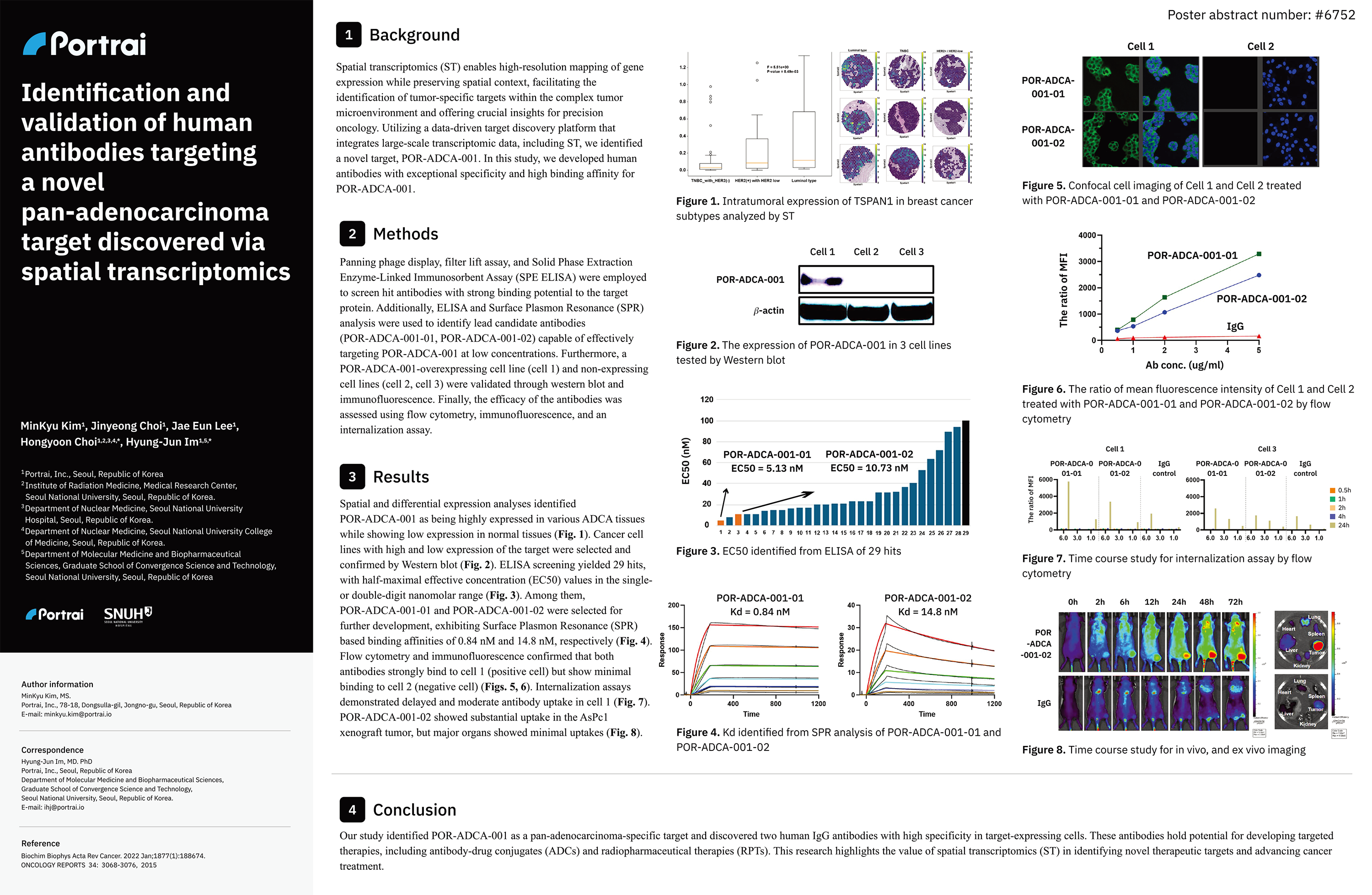
Background: Adenocarcinoma (ADCA) is a type of cancer that originates in glandular epithelial cells in various organs such as pancreas, colon and lung. Spatial transcriptomics enables the high-resolution mapping of gene expression within the tumor microenvironment, preserving spatial context. This allows for the identification of tumor-specific targets in the context of complex tumor microenvironment, providing insights critical for precision oncology. Through a data-driven target discovery platform which leverages large scale transcriptomic data including ST, a novel target, POR-ADCA-001, was identified. Here, we developed human antibodies that have superior specificity and binding affinity to POR-ADCA-001.
Methods: Panning phage display, filter lift assay, and Solid Phase Extraction Enzyme-Linked Immunosorbent Assay (SPE ELISA) were utilized to screen hit antibodies with strong binding potential to the target protein. Furthermore, ELISA and Surface Plasmon Resonance (SPR) analysis were used to identify lead candidate antibodies (POR-ADCA-001-01, POR-ADCA-001-02) that can effectively target POR-ADCA-001 at low concentrations. Moreover, a cell line overexpressing POR-ADCA-001 (cell-1) and a non-expressing cell line (cell-2) were validated using western blot and immunofluorescence. At last, we examined the effectiveness of the antibodies using flow cytometry, immunofluorescence, and internalization assay.
Results: Spatial and differential expression analyses revealed POR-ADCA-001 as highly expressed in various ADCA tissues with low expression in normal tissues. On ELISA, 28 hits were found and the half maximal effective concentration (EC50) values of them were one or two digit nM. Among them, POR-ADCA-001-01, 02 were selected for further development and demonstrated the binding affinity of 0.84 and 14.8 nM. We demonstrated using flow cytometry and immunofluorescence that the two antibodies bind strongly to cell-1 but hardly bind to cell-2. Internalization assays confirmed substantial uptake of the antibodies in cell-1, with minimal activity in control cell lines.
Conclusion: Our research identified POR-ADCA-001 as a target specific to pan-adenocarcinoma and discovered two human IgG antibodies that demonstrate high specificity and effective internalization in cells that express the target. These antibodies could be utilized for the development of targeted therapeutics such as antibody-drug conjugates (ADCs) or radiopharmaceutical therapies (RPTs). This study emphasizes the promise of ST in uncovering new therapeutic targets and improving cancer treatment.
Authors
MinKyu Kim, Jinyeoung Choi, Jae Eun Lee, Hongyoon Choi, Hyung-Jun Im