
doi: https://aacrjournals.org/cancerres/article/85/8_Supplement_1/2502/758334
Poster
Abstract
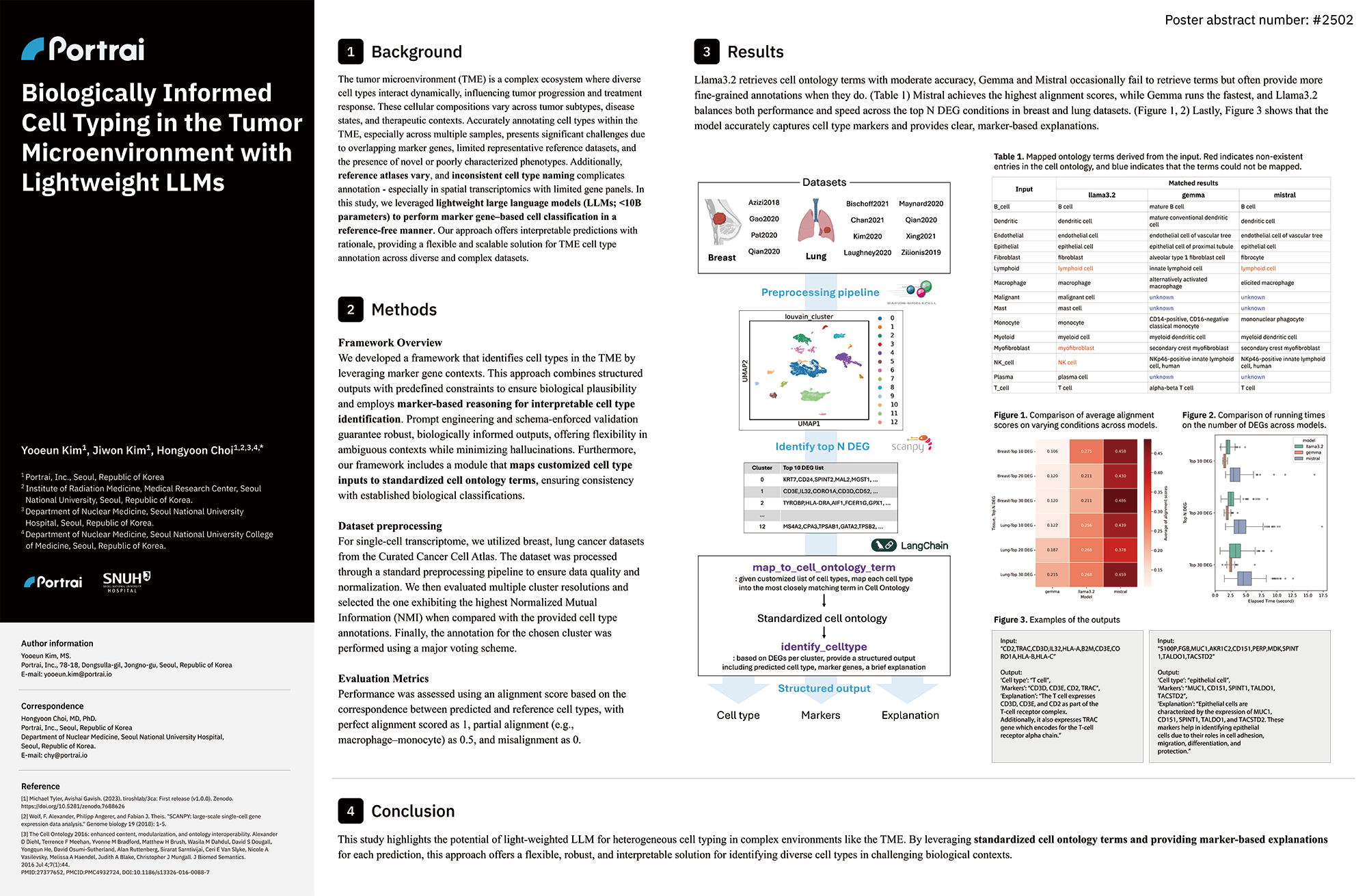
Background: The tumor microenvironment (TME) is a complex ecosystem of diverse cell types that interact dynamically, influencing tumor development and therapy response. Accurate cell type annotation in the TME is challenging due to partial overlap among marker genes, scarcity of representative reference datasets, and emergence of novel cell phenotypes. Our approach uses open-source Large Language Models (LLMs) including Llama 3.2 to provide a reference-free, efficient, and controllable method for cell type classification based on marker genes. Unlike tools that depend on curated reference datasets, this method demonstrates consistent performance across a wide range of cell types. By generating rationale for predicted cell types, our method offers a practical and interpretable framework for annotating diverse cellular populations while offering adaptability to the complexities of the TME.
Methods: LangChain is a “Swiss-knife” platform for LLM applications. We developed a framework identifying cell types in the TME leveraging marker gene contexts. This approach combines structured outputs with predefined constraints to ensure biological plausibility and marker-based reasoning for interpretable cell type identification. Prompt engineering and schema-enforced validation ensure robust, biologically informed outputs, offering flexibility in ambiguous contexts while minimizing hallucinations.
Results: Our method successfully identifies cell types in several cancer datasets, demonstrating high interpretability and reduced misclassification compared to competing methods, such as ScType and GPTCelltype. By employing a de novo cell typing approach, the model effectively resolves ambiguities in overlapping marker genes and adapts well to complex cell populations. The method also achieves superior performance in terms of agreement scores, TTFT (time-to-first-token), and TPOT (time-per-output-token), highlighting its efficiency in time-critical tasks. Explanations provided by the LLM support biological relevance and enhance user confidence in cell typing tasks.
Conclusion: This study highlights the potential of light-weighted LLM for heterogeneous cell typing in complex environments like the TME. By circumventing the limitations of other cell typing methods, including those of reference-dependent and independent, this approach offers a flexible, robust, and interpretable solution for identifying diverse cell types in challenging biological contexts.
Authors
Yooeun Kim, Jiwon Kim, Hongyoon Choi