
doi: https://aacrjournals.org/cancerres/article/85/8_Supplement_1/5074/757581
Poster
Abstract
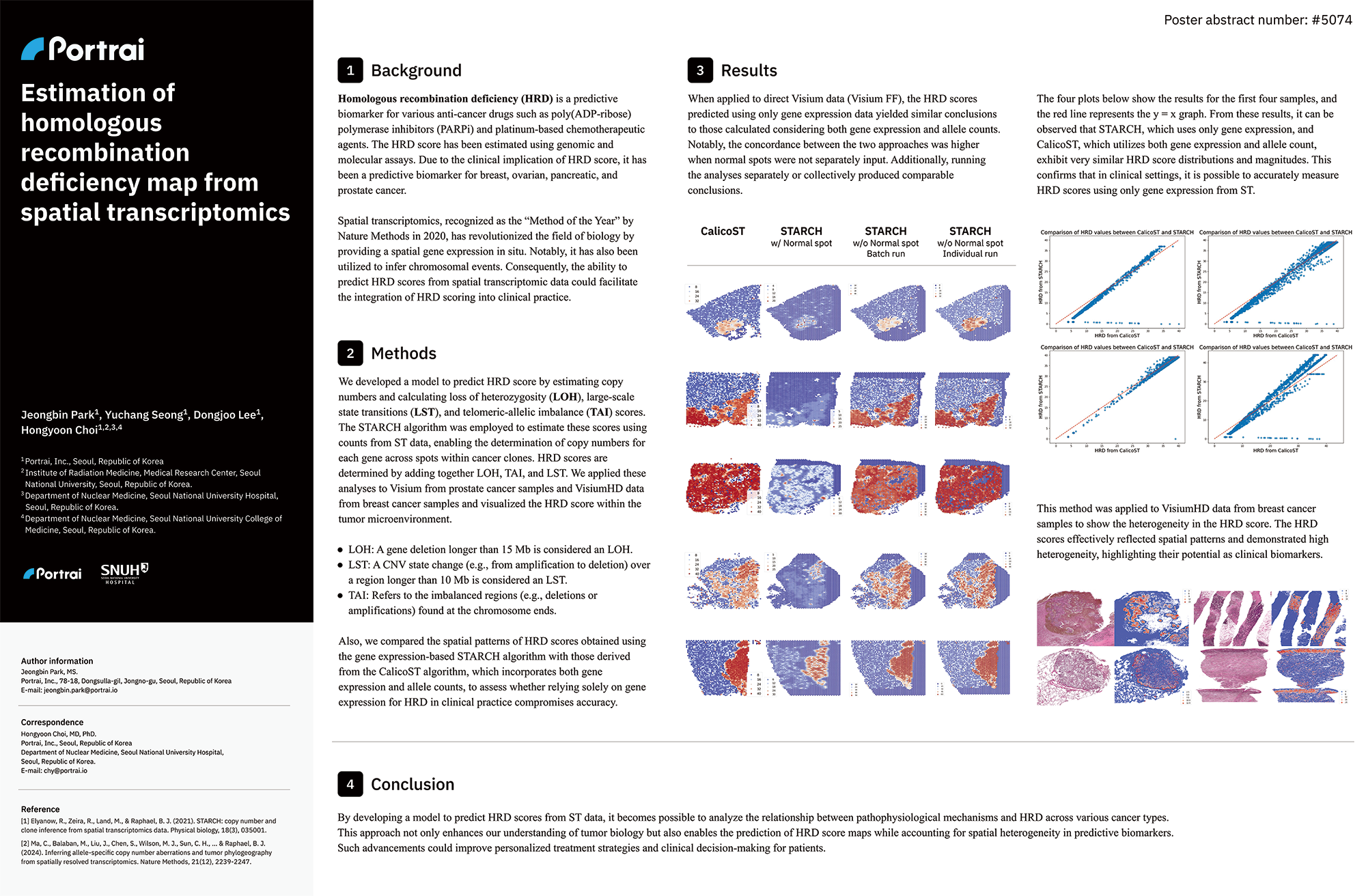
Background: Homologous recombination deficiency (HRD) is a predictive biomarker for various anti-cancer drugs such as poly(ADP-ribose) polymerase inhibitors (PARPi) and platinum-based chemotherapeutic agents. The HRD score has been estimated using genomic and molecular assays, even though due to cancer heterogeneity, HRD could vary in the tumor microenvironment. Here, we developed a model to predict HRD score by estimating copy numbers and calculating loss of heterogeneity (LOH), large-scale state transitions (LST), and telomeric-allelic imbalance (TAI) scores resulting in exhibiting both spatial coherence and heterogeneity, making them suitable for clinical biomarkers addressing tumor heterogeneity. To estimate these scores with counts from ST data, STARCH algorithm was utilized and the copy number for each gene across spots within cancer clones was obtained. HRD scores are determined by adding together LOH, TAI, and LST. We applied these analyses to Visium and VisiumHD data from breast cancer samples and visualized the spatial distribution of the HRD score within the cancer cell map in the tumor microenvironment.
Result: This method was applied to both Visium and Visium HD data to show the heterogeneity in the HRD score. The HRD scores effectively reflected spatial patterns and demonstrated high heterogeneity, highlighting their potential as clinical biomarkers. Furthermore, when applied to direct Visium data (Visium FF), the HRD scores predicted using only gene expression data yielded similar conclusions to those calculated considering both gene expression and allele counts. Notably, the concordance between the two approaches was higher when normal spots were not separately input. Additionally, running the analyses separately or collectively produced comparable conclusions.
Conclusion: By developing a model to predict HRD scores from ST data, it becomes possible to analyze the relationship between pathophysiological mechanisms and HRD across various cancer types. This approach not only enhances our understanding of tumor biology but also enables the prediction of HRD score maps while accounting for spatial heterogeneity in predictive biomarkers. Such advancements could improve personalized treatment strategies and clinical decision-making for patients.
Authors
Jeongbin Park, Yuchang Seong, Dongjoo Lee, Hongyoon Choi