doi: https://aacrjournals.org/cancerres/article/84/6_Supplement/7398/735238
Poster
Abstract
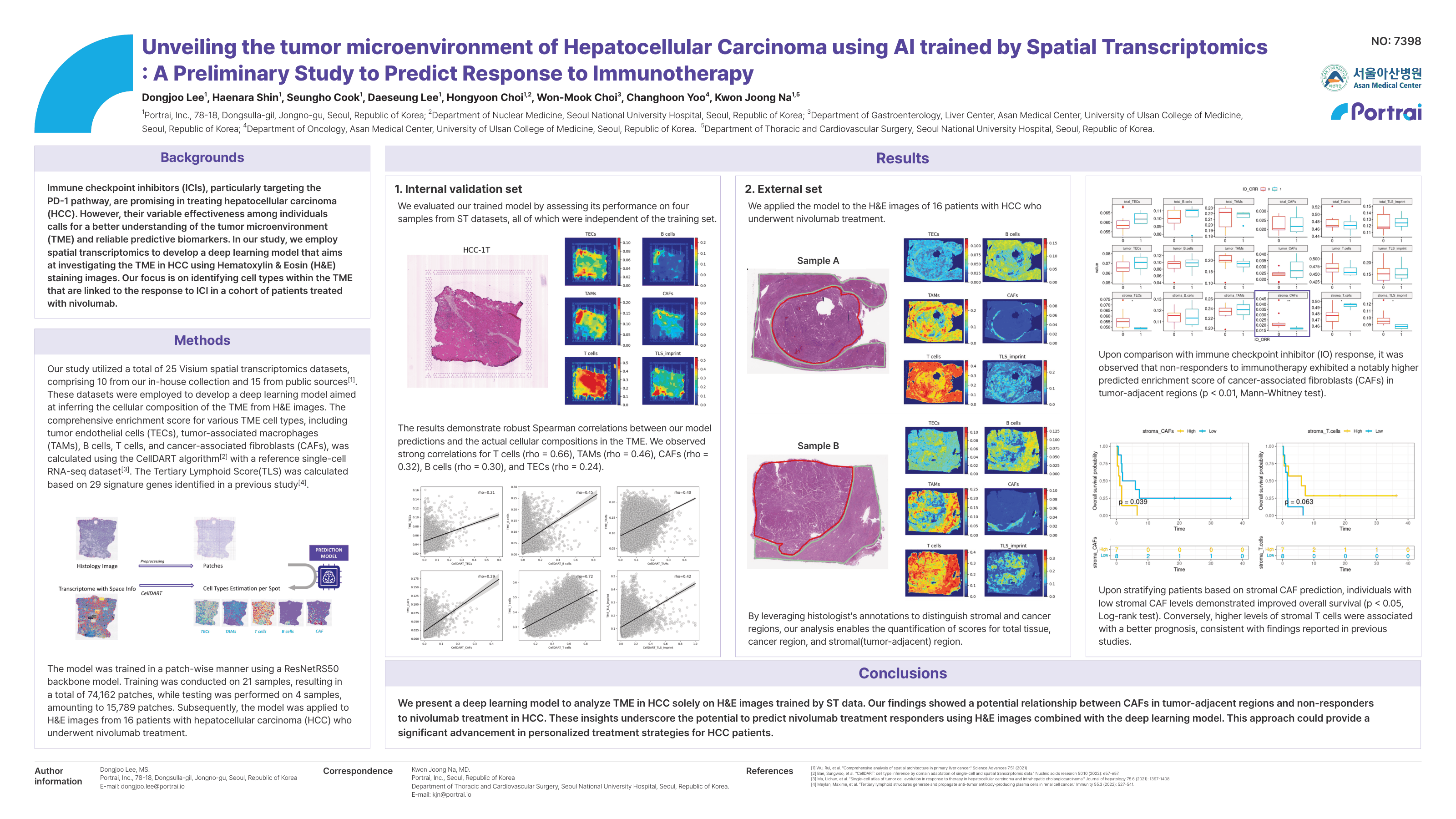
Background: Immune checkpoint inhibitors (ICIs), particularly targeting the PD-1 pathway, are promising in treating hepatocellular carcinoma (HCC). However, their variable effectiveness among individuals calls for a better understanding of the tumor microenvironment (TME) and reliable predictive biomarkers. Here, we employ spatial transcriptomics (ST) to develop a deep-learning model that aims to investigate the TME in HCC using Hematoxylin and eosin (H&E) staining images. Our focus is on identifying cell types within the TME that are linked to the response to ICI in a cohort of patients treated with nivolumab.
Methods: Our study leveraged 21 Visium ST datasets from HCC to develop a model aimed at inferring the cellular composition of TME from H&E images that matched with ST data. The comprehensive TME cell types enrichment score, encompassing Tumor Endothelial Cells (TECs), Tumor-Associated Macrophages (TAMs), B cells, T cells, and Cancer-Associated Fibroblasts (CAFs) in each spot, was calculated by the CellDART algorithm, a method that maps cell type by integrating with a reference scRNA-seq data. The model was trained in a patch-wise manner, utilizing a pre-trained ResNetRS50 as the backbone model. For the internal validation, Spearman correlation coefficients were evaluated for predicted cell types using H&E, and the trained model was correlated with cell type enrichment scores estimated by ST datasets of 4 samples independent of the training set. The model was applied to H&E images of 16 patients with HCC who underwent nivolumab treatment. The model predicted the 5 cell types enrichment score in the tumor and tumor-adjacent normal liver tissues.
Results: The internal validation set results demonstrate robust Spearman correlations between our model predictions and actual cellular compositions in the TME. Specifically, we observe strong correlations for T cells (rho = 0.66), TAMs (rho=0.46), CAFs (rho=0.32), B cells (rho=0.30), and TECs (rho=0.24). When we applied the model to the H&E images of the cohort of patients who underwent nivolumab, immunotherapy non-responders showed a significantly higher predicted enrichment score of CAFs in tumor-adjacent regions (Mann-Whitney test, p<.01). Upon stratifying patients based on stromal CAF prediction, those with low stromal CAF levels exhibited better overall survival (Log-rank test, p<.05).
Conclusions: We present a deep learning model to analyze TME in HCC solely on H&E images trained by ST data. Our findings showed a potential relationship between CAFs in tumor-adjacent regions and non-responders to nivolumab treatment in HCC. These insights underscore the potential to predict nivolumab treatment responders using H&E images combined with the deep learning model. This approach could provide a significant advancement in personalized treatment strategies for HCC patients.
Authors
Dongjoo Lee, Haenara Shin, Seungho Cook, Daeseung Lee, Hongyoon Choi, Won-Mook Choi, Changhoon Yoo, Kwon Joong Na