Democratizing analysis does not mean hiding complexity. It means enabling more people to inspect that complexity.
A researcher’s work does not end when a spatial transcriptomics experiment is complete. They must prepare servers, transfer large files, and align the versions of their analysis packages. Only after fixing code that will not run and resolving memory shortages can they open the results of the tissue analysis.
The challenge does not end there. Researchers must simultaneously interpret locations on pathology images, the cell types of millions of cells, the expression of thousands of genes, and patients’ clinical information. Each type of data may be familiar on its own, but connecting them within a single screen and a unified thought process is difficult.
The bottleneck in spatial transcriptomics analysis extends beyond coding itself. It lies in the cognitive complexity of turning data into reliable questions and decisions.
Processing Data Is Not the Same as Exploring It
Conventional analysis workflows are effective at answering predefined questions. An analyst writes the code and delivers the results as figures and tables, which the researcher then interprets. Every time a new question arises, however, another analysis must be requested.
With spatial data, questions continue to evolve during visual exploration. After identifying cells with high levels of a particular target, a researcher may want to examine the surrounding immune cells and then determine whether the same pattern recurs in patients with different treatment histories. The longer the feedback loop between analysts and biologists, the more likely important questions are to be deferred.
Quickly displaying a single slide is therefore not enough. Researchers must be able to apply the same conditions across multiple patients and slides and compare the results. This is why they need tools such as an in-silico TMA, which virtually assembles regions of interest from individual patients, or a virtual cohort, which instantly groups patients who meet specified criteria. (Cohortlab link)
Natural Language Lowers the Barrier, but Does Not Guarantee the Right Answer
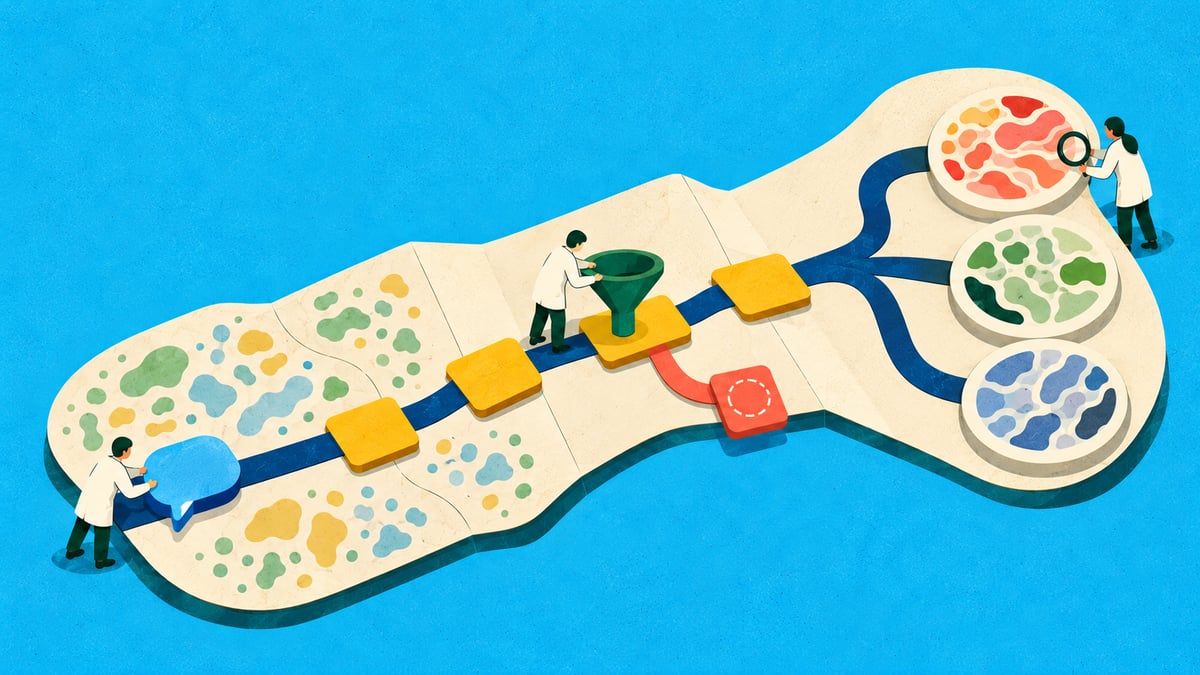
Browser-based acceleration technologies such as WebGPU make it possible to visually explore large-scale spatial data on the web without installing separate high-performance software. A natural-language agent can translate a question such as “Show me cancer cells with high target levels that are close to T cells” into filters and analysis commands.
An easy-to-use interface, however, does not automatically make an analysis accurate. Terms such as “high,” “close,” and “sufficient” require thresholds and distance definitions. If the ambiguity of natural language remains hidden while only plausible-looking results are presented, incorrect analyses can be produced faster than ever before.
This is why no-code does not automatically mean democratization. Users must be able to see and modify how their natural-language questions have been translated into data selections, filters, and statistical methods.
Democratization does not mean hiding complexity. It means making complexity inspectable.
Exploration and Confirmation Must Be Separated
In the short term, exploratory and confirmatory analyses must be distinguished. Visual exploration and natural-language agents are useful for generating hypotheses, but final conclusions must be based on predefined criteria and statistical validation.
Every analysis should retain a lineage record documenting the data, parameters, software versions, and processing sequence used. Another researcher should be able to run the same question and obtain the same result.
In the medium term, analysts and biologists need an environment where they can review results together on the same screen. Biologists must provide the cellular and tissue context, while analysts must assess data quality and statistical assumptions. Good UX does not eliminate either expert. It connects their judgment.
In the long term, organizations should be able to choose among cloud, private VPC, and on-premises environments according to data sensitivity and intended use. Even fast visualization tools are unlikely to be used repeatedly if their computing costs are prohibitively high. UX and infrastructure must therefore be designed together from the outset.
Lessons Portrai Has Learned
While developing Explorer and a natural-language agent for exploring large-scale spatial data, Portrai found that researchers did not necessarily want more analytical features. Their more important need was to move beyond server and code management, test biological questions immediately, and compare the same phenomenon across multiple patients.
At the same time, Portrai found that convenience can undermine trust when filters and thresholds are hidden. Natural-language questions must be translated into explicit analysis steps, and users must be able to review and reuse those steps. An agent should not be an automated response system that replaces the analyst. It should serve as a translator between researchers and their data.
Code-based analysis for experts remains essential. A standardized interface may not be sufficient for developing new algorithms, performing complex statistical modeling, or producing results used in regulatory or clinical decisions. A good platform should simplify repetitive tasks rather than eliminate code, while clearly defining where expert analysis is required.
The Next Five Years
In an optimistic scenario, environments in which researchers can propose hypotheses in natural language, immediately examine them across multiple patients, and convert them into reproducible analyses may become commonplace.
More realistically, standardized exploration and comparison capabilities will be adopted first, while expert review will remain necessary for high-risk decisions. Conversely, if convenient AI interfaces obscure data provenance and analysis processes, visually compelling results and misplaced confidence may increase together.
Ultimately, making analysis easier is not the same as making it trustworthy. In the next article, we will examine trust, reproducibility, and standardization, the final requirements for spatial transcriptomics to move beyond a research tool and become standard infrastructure for the industry.