Portrai VGL- Core AI of World Model From Cell-as-Text to In Silico Spatial Biology
Spatial biology and single cell omics have reached an interesting point.
We now have millions of cells across thousands of datasets, covering diverse tissues, diseases, and experimental conditions. The question is no longer whether we can measure single cells, but rather:
Can we generate new single cells in silico based on what we have already learned?
This post introduces an experimental approach we are developing at Portrai:
using large language models (LLMs) to generate synthetic single-cell RNA-seq data from cell metadata alone.
Rethinking a Single Cell
Traditionally, a single cell is represented as a high-dimensional numeric vector—thousands of genes with expression values.
We asked a different question:
What if a single cell could be represented as a long piece of text?
Instead of treating gene expression as a vector, we describe it as a sequence of gene names and expression scales.
A single cell becomes a paragraph-length description of gene expression, and generating a cell becomes a text generation problem.
This framing allows us to leverage what modern LLMs are exceptionally good at:
modeling long-range dependencies,
generating coherent sequences,
and conditioning outputs on structured inputs.
Cell Generation as Language Generation
Our model takes cell metadata as input, such as:
tissue or organ,
disease context,
experimental or perturbation conditions.
From this metadata, the model autoregressively generates a long gene-expression sequence between special tokens:
<START_GEN> … <END_GEN>
Each generated sequence is typically 8,192 to 16,000 tokens long.
To put this in perspective:
One generated cell contains roughly the same amount of information as a long review article.
Once generated, the text is parsed and converted back into numeric gene expression values, yielding a fully functional single-cell RNA-seq profile.
Multiple generated cells are then aggregated into a standard single-cell omics / spatial biology data structure (AnnData), making them immediately compatible with existing single-cell analysis pipelines.
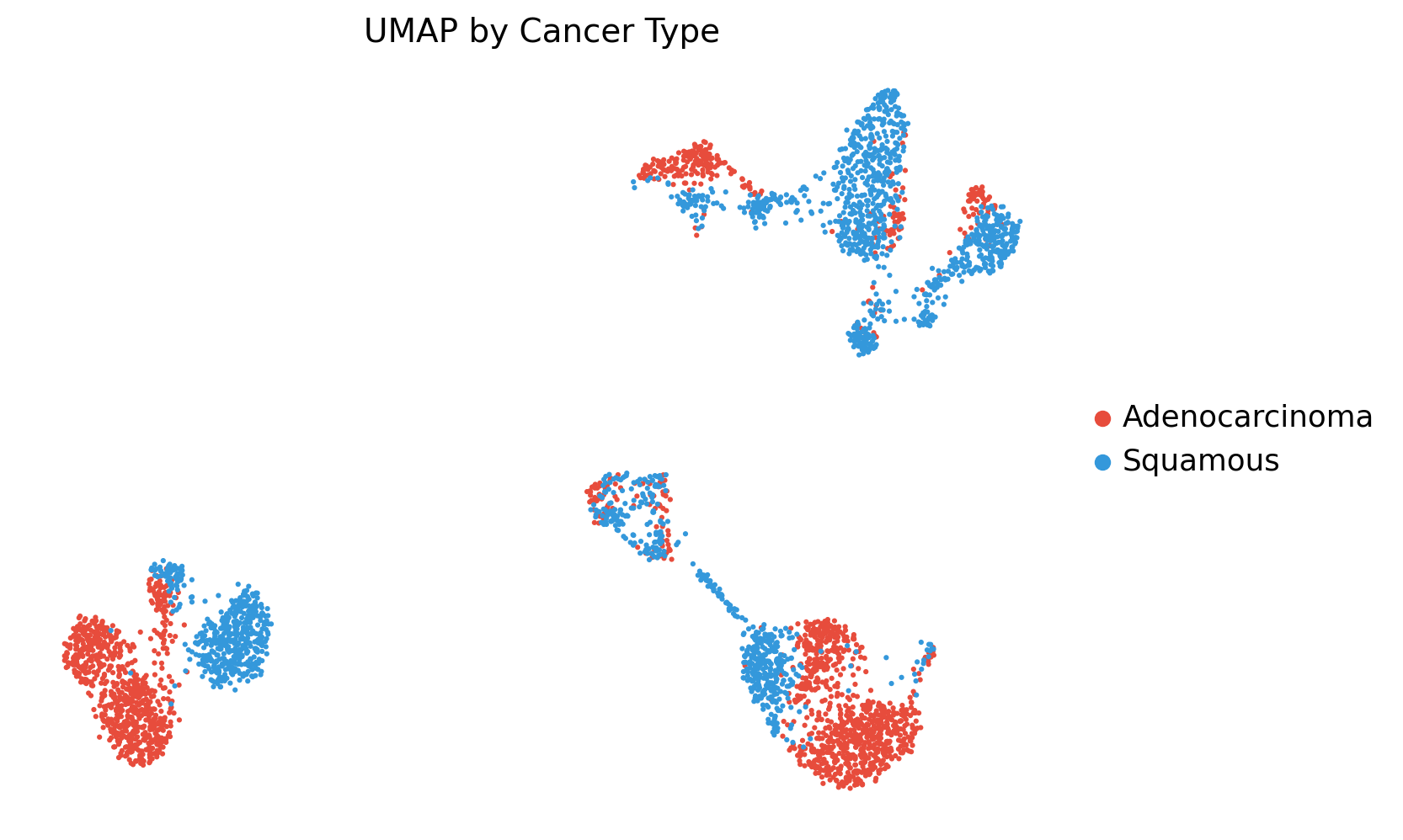
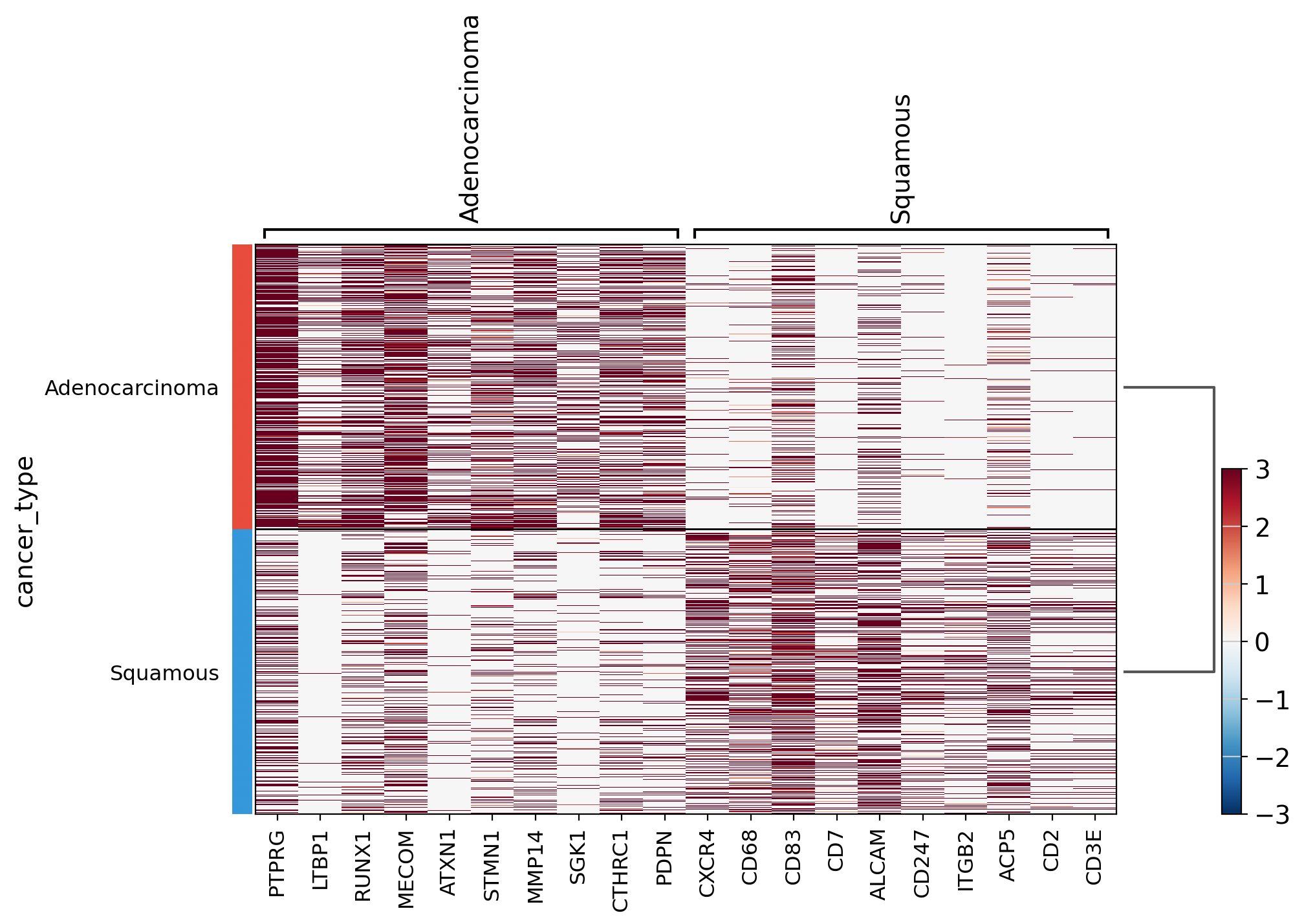
The figures below show “Synthetic Cell Data” generated by the VGL-Cell Generator—an in silico dataset of over 4,000 cells derived solely from condition-level inputs (lung squamous cell carcinoma and lung adenocarcinoma).
Notably, generating just 4,000 synthetic cells requires processing text equivalent to roughly two hundred average-length books, highlighting the scale and richness of the underlying generative representation.
From Text Back to Biology
Although the intermediate representation is text, the output is not.
After generation:
Gene–expression tokens are parsed,
Expression levels are mapped back to numeric values,
A cell-by-gene matrix is reconstructed,
The result is stored as a synthetic scRNA-seq dataset.
From there, everything works as usual:
quality control,
clustering,
cell typing,
differential expression,
pathway analysis.
In the near future, downstream tools are hard to distinguish whether the data came from a sequencer or from a language model.
Why This Matters: Unlimited Virtual Dataset Generation
This approach fundamentally changes what is possible with single-cell and spatial omics data.
Instead of being limited to what has been experimentally measured, we can now:
Generate single-cell transcriptomes for a specific cancer type,
Simulate how cells might look under different biological conditions,
Explore hypothetical scenarios that are difficult or impossible to test experimentally.
In other words:
Single-cell biology from human disease becomes an in silico experimental space.
Virtual Experiments in Single-Cell Biology
Because the generation process is conditional, we can systematically vary inputs and observe changes in the generated cells.
Examples include:
Generating cells from the same tissue under different disease states,
Comparing virtual cohorts across stages of cancer,
Forcing specific genes to be high or low and observing how cellular programs shift,
Exploring tumor microenvironment responses without requiring matched experimental datasets.
These experiments are not meant to replace wet-lab validation, but to rapidly explore hypotheses from in silico generative biology
Scaling Beyond Observed Data
One important consequence of this framework is scalability.
Once trained, the model is no longer bounded by:
dataset size,
sample availability,
licensing constraints.
Instead, it can generate:
thousands to millions of cells,
across conditions that may be rare, under-sampled, or not yet experimentally measured.
This makes the approach particularly attractive for:
reference dataset generation,
exploratory analysis in underrepresented biological contexts.
The Role of LLMs
Language models are often viewed as tools for text, code, or images.
Here, they play a different role:
LLMs act as generative models of biological programs once they understand cell’s languages
By learning from large-scale single-cell data, the model internalizes patterns such as:
co-expression structures,
cell-type-specific programs,
condition-dependent shifts in gene expression.
The output is not a copy of any single real cell, but a new, plausible realization consistent with learned biological constraints.
This Is Just the Beginning
Cell-level generation is only the first step.
At Portrai, this work feeds directly into our broader roadmap centered around VGL (Vision–Gene–Language) models.
Our long-term direction is Generative Biology:
generating not just individual cells,
but spatially organized tissues in silico.
By extending conditioning inputs to include:
spatial coordinates,
histological context,
imaging-derived features,
we aim to generate virtual spatial biology datasets that capture how cells are arranged, interact, and organize in tissue.
Toward a Human-Centered World Model for Drug Discovery
The ultimate goal goes beyond data generation.
Portrai’s vision is to build a Human-Centered World Model for Drug Development, where we can:
simulate how biological systems are structured in human tissue,
predict how drugs distribute spatially,
model how they act on specific cell populations,
and anticipate downstream biological responses.
In this framework:
Vision models understand tissue morphology,
Gene models capture molecular programs,
Language models unify these representations into a generative, interpretable system.
Together, they form a VGL-based generative world model of human biology.
A Shift in Perspective
This project represents a shift in how we think about single-cell data.
From:
“We analyze the cells we can measure.”
To:
“We generate the cells we want to understand.”
Single-cell biology moves from passive observation toward active, generative exploration—opening new possibilities for discovery, hypothesis testing, and ultimately, drug development.
More to come as we scale this approach toward spatial biology and drug-level world modeling.