The Rise of Spatial Biology
A Shift in How We View Biology
Our approach to investigating biological phenomena and understanding disease has long begun with identifying changes at the cellular and molecular levels. The idea that disease can be treated by identifying the function of a specific molecule and modulating it has led directly to the concrete practice of drug discovery, creating research and development processes that unfold over decades-long cycles.
Throughout this process, biological data accumulated gradually, but its growth remained relatively modest. Studying one gene, one protein, or one pathway at a time provided depth, but this approach remained fundamentally within the framework of hypothesis-driven research.
The balance began to shift decisively with the emergence of spatial biology.
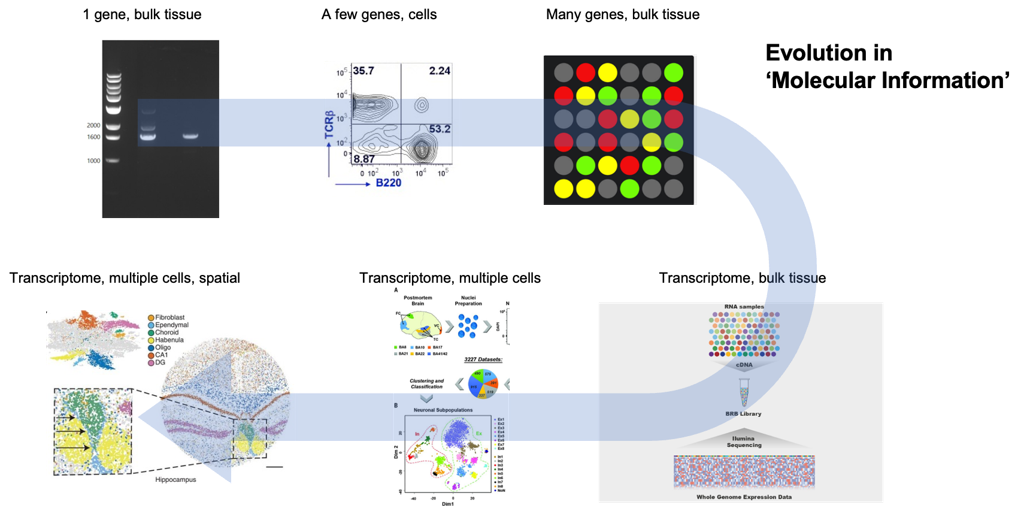
The Catalyst for a Data Explosion: Spatial Biology
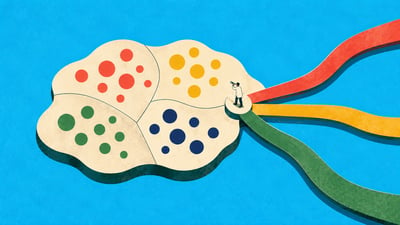
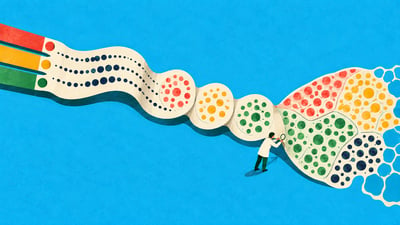
In 2020, spatial transcriptomics was named Method of the Year by Nature Methods. In 2024, spatial proteomics received the same recognition. These milestones represent more than technological achievements. They signal that biology is moving beyond averaged bulk data and single modalities into a field where molecular information can be integrated across the new dimension of space.
Where does gene expression occur within a tissue? In what cellular and neighboring contexts do proteins function? How do these layers of information interact to produce disease phenotypes? For the first time, spatial biology has begun to provide data-driven answers to these questions.
As a result, the paradigm of biological research is rapidly shifting:
From forming a hypothesis first and then examining the data
To collecting data first and generating and testing an unlimited number of hypotheses from it
At the heart of this shift is the scale of the data.
Hundreds of Gigabytes from a Fingernail-Sized Tissue Sample
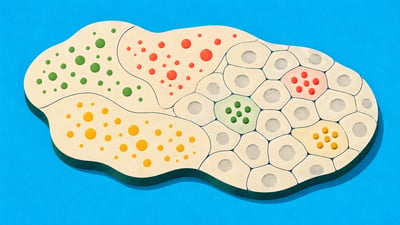
Today, spatial biology can generate hundreds of gigabytes of data from a single fingernail-sized tissue slice. Tens of thousands of cells, thousands of genes or proteins, and the spatial relationships among them can all be captured as data.
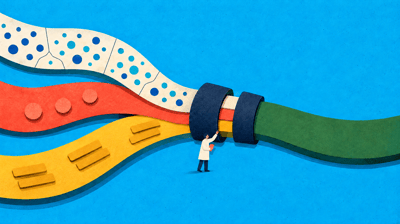
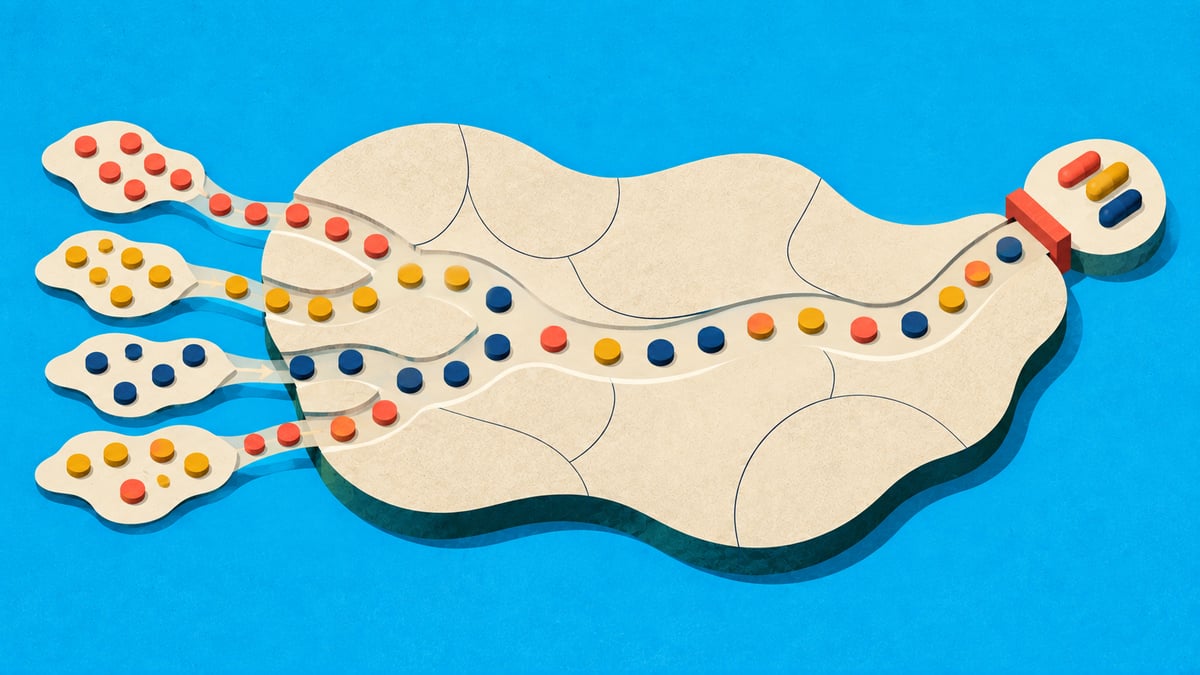
This volume and complexity can no longer be managed through human intuition or conventional analytical methods alone. This is where the convergence with AI becomes inevitable. Spatial biology provides an ideal data environment in which AI can operate effectively, while AI serves as the engine that interprets complex, multidimensional spatial information and transforms it into actionable knowledge.
This convergence goes beyond automating analysis. It is redefining roles across biology and drug discovery.
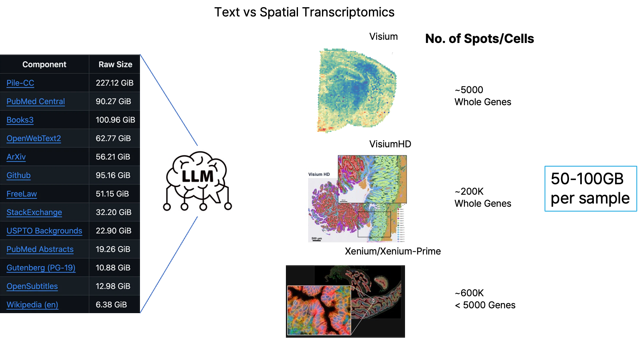
The Age of AI Agents: From Analytical Tools to Decision-Making Systems
The Changing Role of Spatial Biology Tools
The rapidly expanding range of spatial biology analysis tools has had a clear purpose: to help us examine data more effectively.
Accurately annotating cell types
Discovering new niches
Visualizing previously unknown spatial patterns
These advances have led to numerous publications and, at times, created new technological trends. Some have become core technologies widely adopted as de facto standards in spatial biology.
With the arrival of the agent era, however, the role of these tools is being fundamentally redefined.
From Tools to Agentic Systems
Most sophisticated tools, particularly well-designed ones, have clearly documented purposes and instructions, along with well-structured codebases. Paradoxically, these qualities make them easier to use through agents. Even researchers without extensive experience or established domain knowledge can readily apply a tool once they understand its purpose and usage.
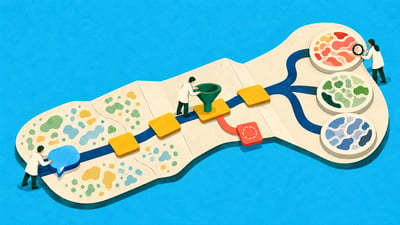
In the era of LLM-based agents, the possibilities extend far beyond using an individual tool for a single purpose. Agents can design higher-level analytical objectives and the workflows required to achieve them, opening a path toward generating complete research outcomes.
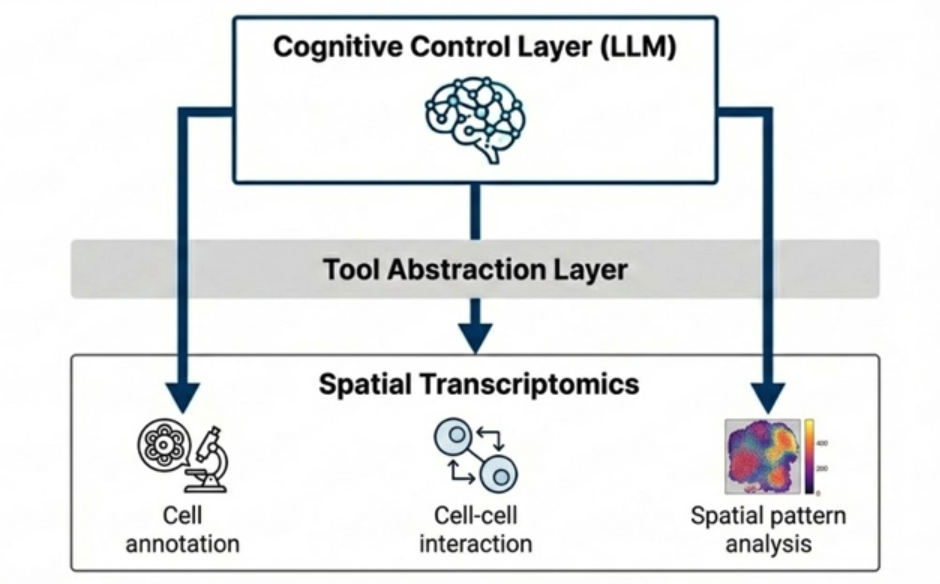
As agentic systems orchestrate these tools, they can accelerate a substantial portion of dry-lab bioinformatics analysis and enable the repeated generation of results. Consequently, the key questions arising from data-driven discovery are moving beyond simply asking, “What did we discover?”
What should we do next based on this complex dataset?
Which targets should be prioritized for validation?
In which indications and patient populations is the probability of success highest?
What is now required is not a tool that merely lists analytical findings, but a system that proposes decisions and actions and turns data-driven discoveries into actionable outcomes that connect naturally to the next stage of drug development.
Spatial biology is no longer simply a supporting method for exploration. It is evolving into a patient-centric, data-driven operating system spanning the entire drug development process.
From Understanding Cell States to Predicting Drug Action
Until only a few years ago, the value of spatial biology as a discovery platform centered on tools for:
Cell type annotation
Cell state definition
Niche discovery
Pathway enrichment
These capabilities have now become baseline requirements.
Today, the more important questions are far more practical and drug-centric. Answering them requires integrating information derived from spatial biology and data collected from individual patients with patient states and clinical heterogeneity across multiple scales.
Where is the target expressed?
In which microenvironments can meaningful drug action actually occur?
How can toxicity and efficacy be distinguished within a spatial context?
As spatial biology becomes increasingly action-oriented, its role is shifting from:
A tool for explaining biology → An engine for predicting how drugs work
This is the process through which spatial biology, combined with AI, is moving beyond exploration and establishing itself as an operating system that creates tangible value in drug development.
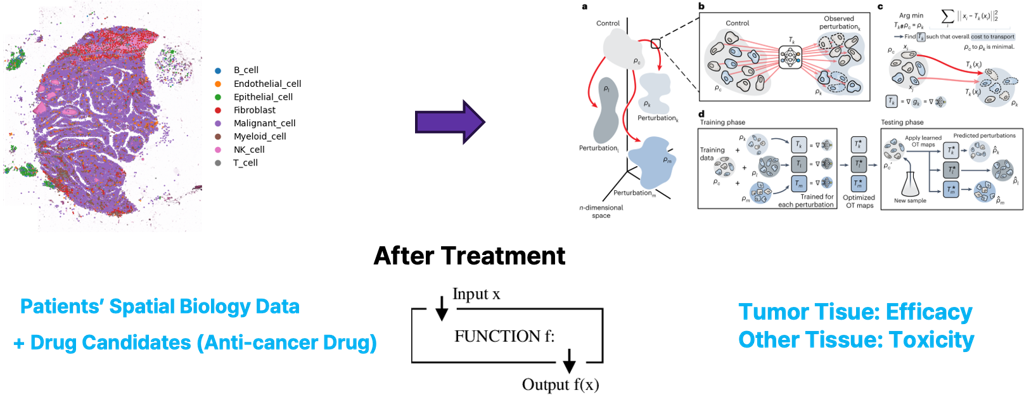
Therapeutic Entities Defined in Spatial Context
Advanced drug modalities such as ADCs, RPTs, bispecific antibodies, and cell therapies share a common characteristic: diseases and drugs involving these modalities can no longer be understood solely in terms of a single molecule acting on a single cell.
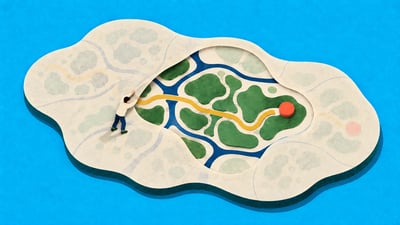
Tumors and human tissues are highly complex systems in which numerous cells interact with one another. The behavior of a drug entering this system cannot be understood using cultured cells in a test tube. Spatial biology, however, provides a direct map of this complex, interacting system. Our next mission is to determine how drugs act within it.
In spatial biology, a drug must now be understood as a system that operates spatially. Predicting its behavior requires combining an understanding of how the drug is physically delivered through space with an understanding of how it acts on diverse and complex cell populations.
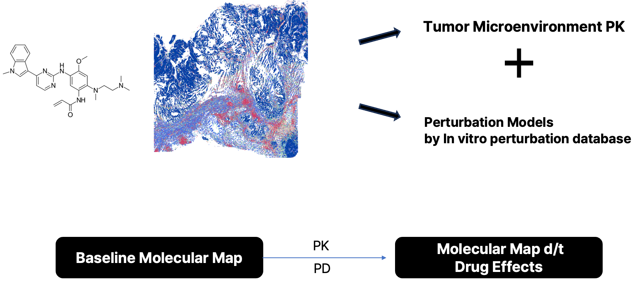
More practically, examples of questions through which we can turn data into concrete actions include:
How far does an administered drug molecule actually penetrate the tumor microenvironment?
In which tissues and microenvironments is the bystander effect amplified?
How does heterogeneity in target expression affect actual efficacy?
Once a drug reaches its destination, how does it interact with the many surrounding cells to produce changes at the disease level?
These questions cannot fundamentally be answered through in vitro experiments or bulk omics data. They can only be defined and interpreted through spatial biology.
Spatial Biology and What Comes Next
Spatial biology has moved beyond being a single technology or analytical methodology. It is reshaping how we understand biology, how we define drugs, and how decisions are made throughout drug development.
Future competitiveness will not depend on producing more data. It will depend on:
How data are integrated
What questions can be generated automatically
Which decisions can be recommended most rationally
This is the new role required of spatial biology in the age of agents.
Spatial biology is no longer a future possibility. The transformation has already begun, and spatial biology is now becoming the operating system at the center of drug development.