The Virtual Patient Is Coming
In October 2025, SOPHiA GENETICS launched an AI-powered digital twin platform — SOPHiA DDM Digital Twins. By integrating a patient's genomic, clinical, and imaging data, the system creates a "virtual patient" and simulates treatment responses. That same year, the FDA announced a phased elimination of mandatory animal testing, formally accelerating the transition toward in silico methodologies. The healthcare digital twin market is projected to grow from $3.4B in 2025 to $31.7B by 2032, at a CAGR of 37.6%.
The promise is clear. Simulate whether a drug will work for a given patient — before treatment begins.
But most digital twins today are built from genomic profiles and clinical variables. Tumor mutations, expression levels, patient history, and biomarkers — these form the virtual patient and predict drug response.
The conventional question: "Which drug matches this patient's genomic profile?" The question Portrai asks: "Can we build a virtual tumor that captures the cell arrangement, immune cell accessibility, and stromal barrier architecture within this patient's tumor?"
Navigation Without a Map: The Blind Spot of Current Digital Twins
Consider two patients.
Patient A and Patient B. Same cancer type, same stage, same driver mutation. PD-L1 expression levels on bulk RNA-seq are comparable. From a conventional digital twin's perspective, these patients are essentially identical. The prediction: both should respond similarly to immunotherapy.
But the outcomes diverge. Patient A responds. Patient B does not.
The difference was not in the genes — it was in space. In Patient A's tumor, CD8+ T cells had infiltrated deep into the tumor parenchyma. In Patient B, the same number of T cells were present, but trapped in the stroma behind a dense barrier of cancer-associated fibroblasts (CAFs) — the "immune exclusion" phenotype we discussed in our June post.
Gong et al. (Cancer Research, 2024) demonstrated this problem head-on. Comparing agent-based models (ABMs) with ODE (ordinary differential equation) models, they showed that ODE models failed to capture spatial immune dynamics. Cell counts and ratios alone could not predict immunotherapy efficacy. Only agent-based approaches — incorporating the physical arrangement and migration dynamics of cells — could reproduce the phenotypic and spatial heterogeneity that determines treatment outcome.
Here's an analogy: building a digital twin from genomic profiles alone is like simulating a city using only demographic data. Population size, age distribution, and income levels won't predict traffic flow without knowing the road network and building layout. Tumors work the same way — beyond cell types and counts, you need the arrangement and architecture to predict how a drug will navigate through tissue.
Giving Virtual Tumors a Spatial Dimension
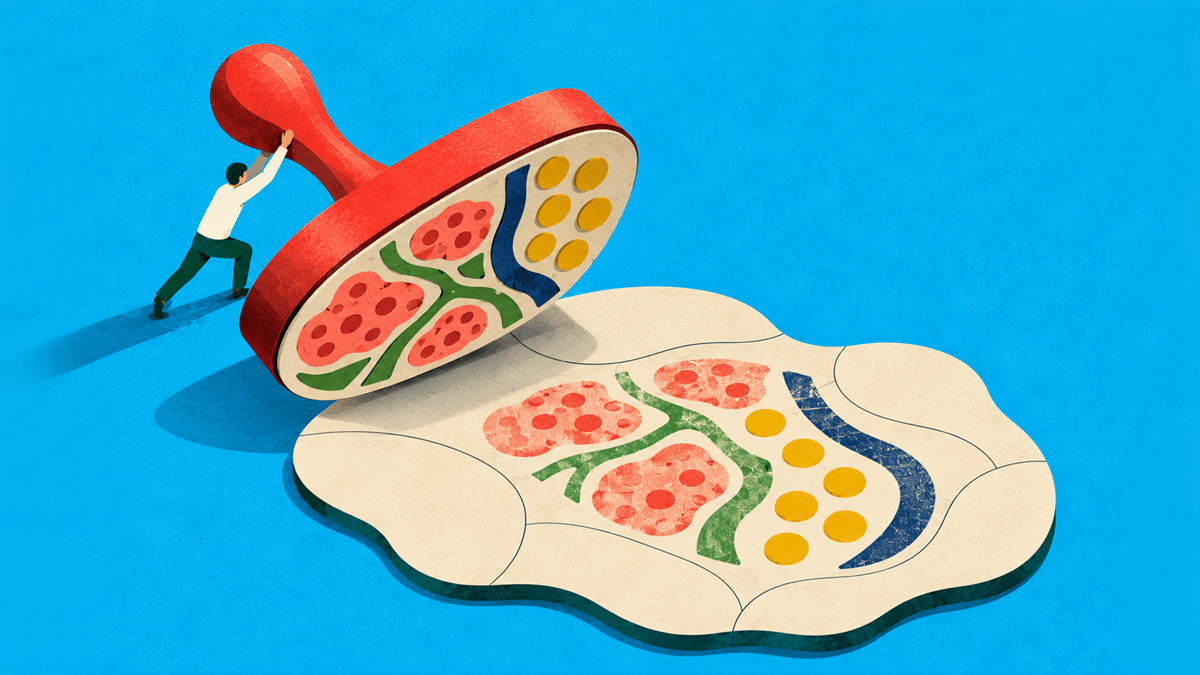
Chen et al. (Cell, 2025) offered one solution to this problem. Using multimodal AI trained on multi-omic data, they generated virtual tumor populations that model the spatial architecture of the tumor microenvironment (TME). Rather than simply replicating individual patients, their approach synthesizes plausible spatial variations from large patient cohorts, producing virtual populations suitable for in silico clinical trials.
This became possible because of the maturation of spatial transcriptomics. The data that spatial transcriptomics provides for digital twins falls into four categories:
Cell positioning. The coordinates of tumor cells, T cells, CAFs, and macrophages. Who is where.
Cell-cell communication. Ligand-receptor signaling between neighboring cells. Who is talking to whom.
Functional zonation. Transcriptomic differences across tumor core, invasive front, and immune niches. The same tumor functions differently depending on location.
Barrier architecture. The spatial arrangement and density of CAFs, the thickness of the ECM — the physical structures that determine whether immune cells can reach their targets.
Notably, Zheng et al. (Cancer Cell, 2025) identified four conserved spatial subtypes of CAFs across 10 cancer types and 7 spatial platforms — peri-epithelial, stromal, peri-vascular, and immune-interacting CAFs. These subtypes were conserved across cancer types, providing a standardized framework for modeling CAF barriers in digital twins.
Seven Months of Questions Converge Into One
This blog series is now seven months old. Each month explored a different modality, but looking back, every question has been converging toward a single framework.
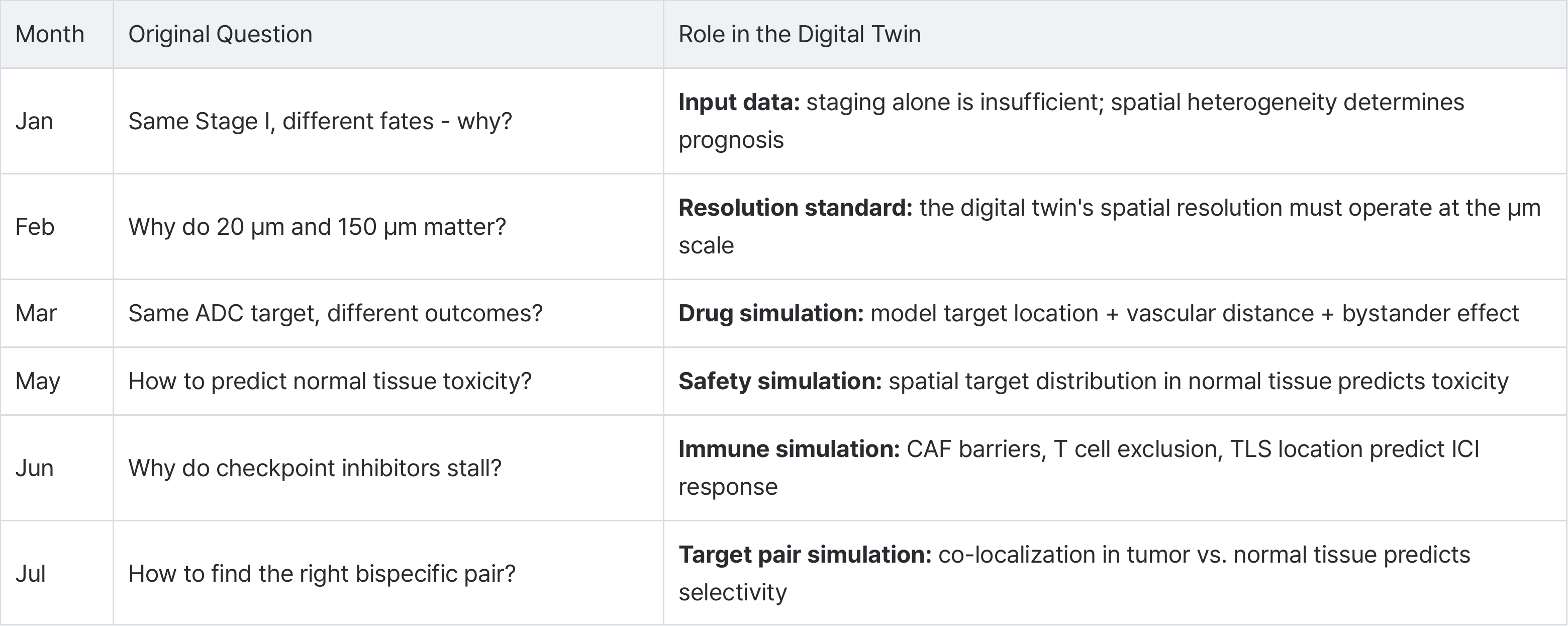
Each was an independent question. But answering all of them ultimately requires a single, spatially complete virtual tumor. Simulating ADC drug delivery (March) requires vascular architecture and target expression coordinates. Predicting IO response (June) requires the spatial arrangement of immune cells and CAFs. Evaluating bispecific selectivity (July) requires co-localization data across both tumor and normal tissue.
The modalities differ, but the spatial data they need is the same. And once that data converges, a single digital twin can simulate drug responses across multiple modalities — comparing ADC, ICI, and bispecific performance on the same virtual tumor.
Conclusion: Virtual Patients Need an Address Too
Digital twins represent the next chapter in precision medicine. Simulating treatments virtually before administration, selecting optimal strategies, predicting toxicity. As Nature Medicine (2026) declared, the era of digital twins and in silico trials has arrived.
But for that promise to hold, the virtual tumor must capture the spatial architecture of the real one.
If the genome is a patient's name, the spatial architecture is their address. A name alone won't deliver a letter. For a digital twin to truly resemble its real counterpart, it needs an address — cell coordinates, barrier thickness, niche boundaries. Only on that spatial ground truth can a simulation become a prediction.
The message running through seven months of this series has been one: the answer is written in space. ADCs, checkpoint inhibitors, bispecific antibodies, and now digital twins — to deliver on their promise, you must first be able to read the space.
References
Chen X, et al. Multimodal AI generates virtual population for tumor microenvironment modeling. Cell. 2025.
Gong C, et al. Agent-Based Modeling of Virtual Tumors Reveals the Critical Influence of Microenvironmental Complexity on Immunotherapy Efficacy. Cancer Research. 2024;84(17):2881-2894. DOI: 10.1158/0008-5472.CAN-23-3669
Zheng L, et al. Conserved spatial subtypes and cellular neighborhoods of cancer-associated fibroblasts revealed by single-cell spatial multi-omics. Cancer Cell. 2025;43(3):549-567. DOI: 10.1016/j.ccell.2025.02.013
The arrival of digital twins and in silico trials in drug development. Nature Medicine. 2026. DOI: 10.1038/s41591-026-04344-3
SOPHiA GENETICS. SOPHiA DDM Digital Twins platform launch. Press Release. October 16, 2025.